

The recent run-up in bitcoin exchange rates and related volatility have created a number of tradable scenarios for thoughtful market participants. One less obvious effect of the dramatic price movement is the tightening of the cross-exchange price differential between Mt. Gox and Bitstamp, the leading USD bitcoin exchanges by volume.
As we first pointed out in June, exchange rates at Mt. Gox and Bitstamp have diverged after Mt. Gox stopped servicing fiat withdrawals for many of its customers. For more background on the causes of this, see our previous research on the matter. More important for market participants at the moment is how these spreads have historically acted and the potential implications on prices at the different exchanges.
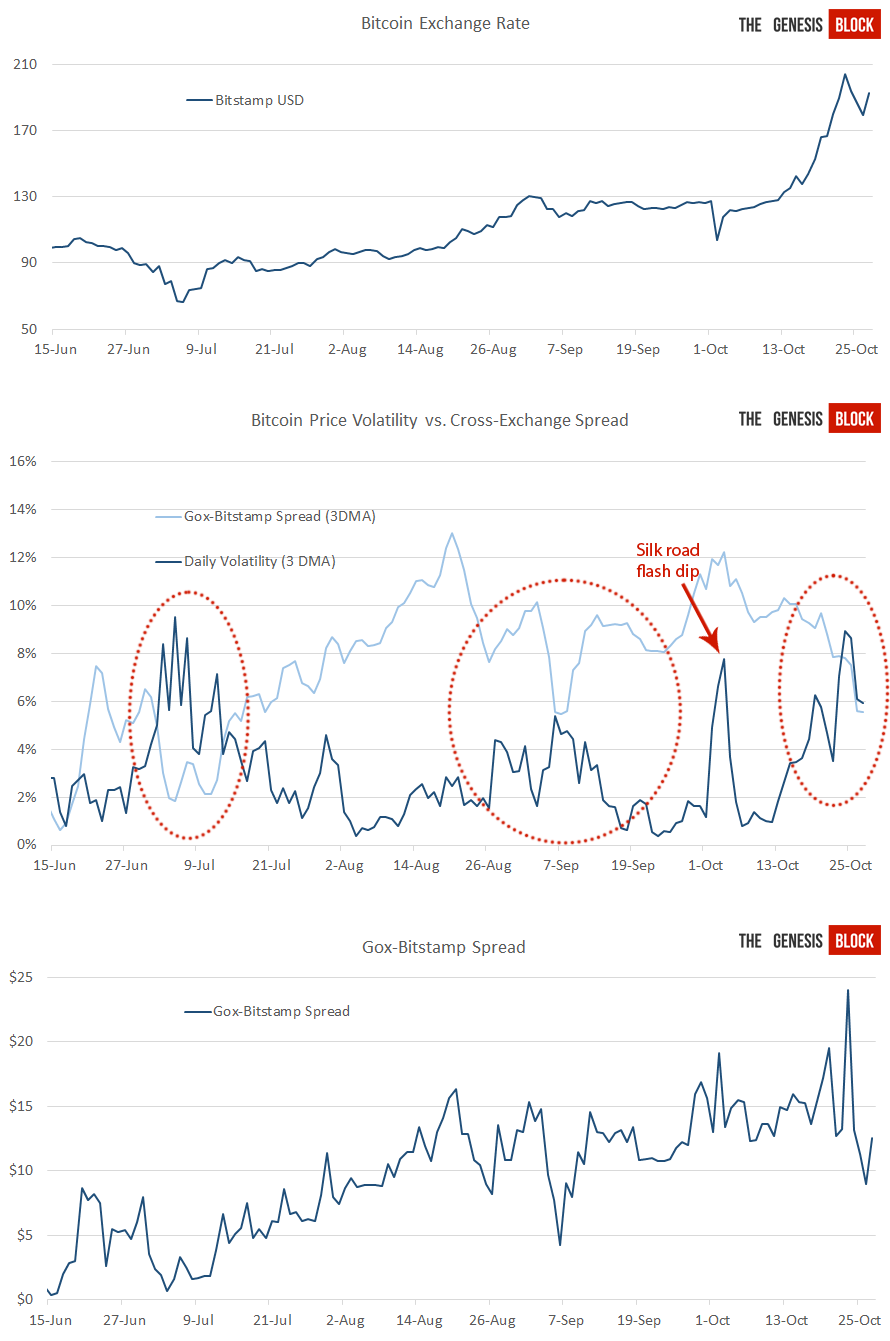
As the cross-exchange spreads became more dramatic, a sense of a normal range has emerged, with divergent levels eventually reverting towards the mean. Over the past few months, a change in spreads has been highly (inversely) correlated with sustained periods of increased price volatility. With dramatic swings in bitcoin exchange rates, cross-exchange dynamics are generally slower to adjust. Looking at the price differential between Mt. Gox and Bitstamp in the chart below, two things become clear. The first is that the differential has generally bounced around 10% and stands at roughly half that level at the time this was written. Second is that volatility and cross-exchange spread are generally inversely correlated.
Just like has happened previously, the recent extended period of volatility has sent the cross-exchange spread to one of the lowest levels in months. Both of the previous times higher-than-average volatility sent the cross-exchange spread downward, the differential eventually reverted to it’s previous levels by means of price adjustments at the two exchanges. Worth noting, the spread has fallen on an absolute basis as well, so the idea that the spread is based on a fiat value rather than a rate premium for inability to withdraw funds seems less likely.
One potential driver for the reduction in spread, albeit less likely, would be an increased share of Mt. Gox customers in locations unaffected by withdraw issues. If more trading is being done by, for example, Asia-based traders, the impact of withdrawal issues is reduced. That said, the likelihood of the impact being related to this is rather low, given the strong correlation with price volatility, the fact that it is a USD market and that a number of Chinese exchanges are currently offering free or very low fee trading.





No Comments