
Towards the end of last week something seemingly unexpected happened in the bitcoin market – the price of BTC rose on unquestionably bad news. After Mt. Gox announced a temporary halt on USD withdrawals, the price of BTC on Gox climbed approximately 5% in a matter of hours. While this may seem like an odd reaction at first, further investigation shows that this is actually a highly consistent and predictable occurrence.
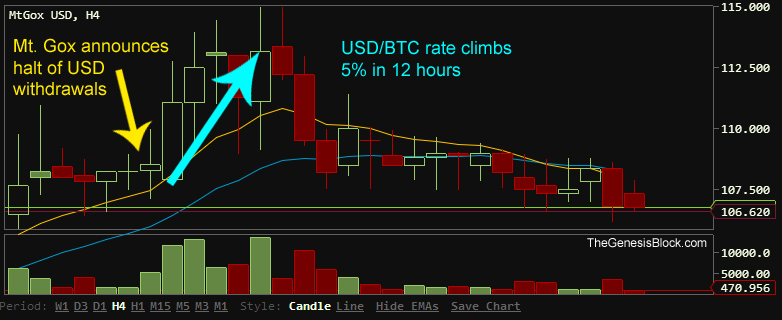
Chart source: bitcoin.clarkmoody.com
The rate change on Mt. Gox, the long-time leader in bitcoin exchange volume, was actually an anomaly. In comparing the price of BTC on Gox with the price other top BTC/USD exchanges, you’ll see a remarkable divergence in prices after the announcement. The price on Gox rose quickly to $113 as prices on the on other exchanges remained relatively stable around $105.
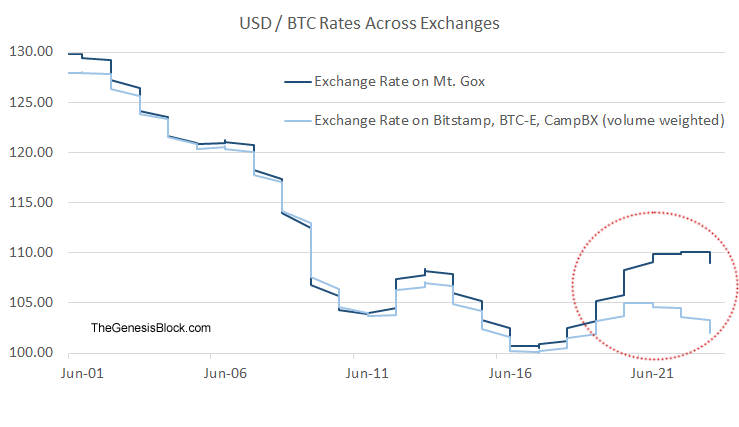
Intuitively, one might think bad news that directly affects one exchange would have a negative impact on that exchange’s core market – so why then did the price of BTC jump so significantly only on Gox? The most likely reason: since USD holdings were frozen from withdrawal on the exchange, traders converted large amounts of USD to BTC, which they could then move freely to another exchange before converting back to USD for a re-balanced and fully-liquid portfolio. This creates a bid for BTC at Gox and drives BTC rates up on the Gox platform, while also creating a bid for USD at other exchanges and keeping BTC rates suppressed outside of Gox.
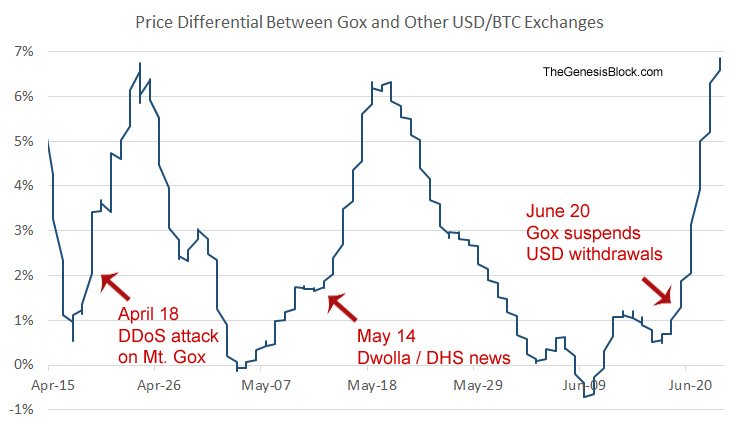
Going back in time, this theory appears to be supported by other major news events. Similar price differentials between Gox and other exchanges can be seen following the April 18th DDoS attack on Gox and the May 14th news that Dwolla would no longer service Mt. Gox. Both times the market reaction was consistent with the withdrawal freeze news from last week – the price differential between Gox and the other exchanges climbed above 6% before eventually returning to a normalized level.
Market inefficiencies like the one described may be reduced over the coming months as the highly-anticipated Coinsetter, expected to launch in July with an exchange aggregator, increases cross-exchange visibility. Until that occurs on a broad scale, events like these will continue highlighting the relative immaturity of the bitcoin market. Some traders are clearly willing to take the loss to buy on Gox and sell for a lower price elsewhere to ensure ample liquidity, but for anyone less concerned with immediate liquidity these types of scenarios can create significant arbitrage opportunities.
Further validating the theory that traders jumped exchanges via BTC is the proportionate change in volume between exchanges when these events and related price differentials occur. With every such event, the volume at non-Gox exchanges climbs relative to volume at Gox, indicating a shift of holdings across exchanges.
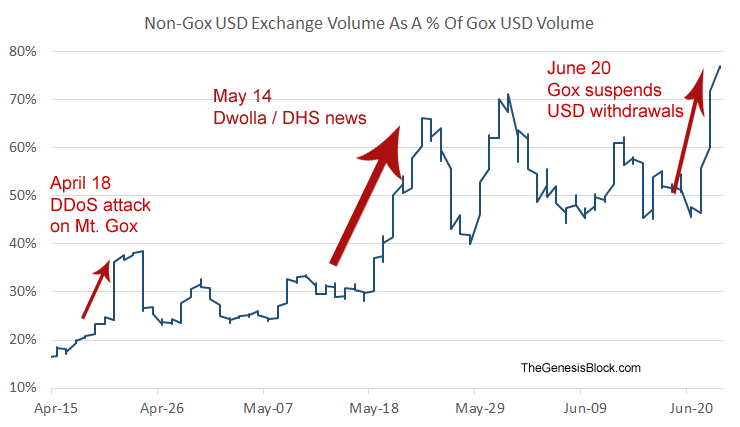
Notably, Gox never seems to fully recover from the lost market share. Shortly after the mid-April crash, the USD volume at non-Gox exchanges combined for less than 20% of Gox’s USD volume. After the latest news that figure has climbed to 80% and, if history is any indicator, the probability of Gox fully recovering that market share appears to be quite low.





What about the spike on the left side of the price differential graph? WHy is that not included in this?
Presumably its because thats when the big crash was so volatility was all over the place and wasnt event related
Awesome analysis but for me (and surely others) the time to fund other exchange accounts is still too high. If I was already set up there this would be good but until then this article is about as close as I’m going to get
Something else to consider: Mt.Gox is artificially keeping the price high to attract people moving over their BTCs from other sources, selling them and keeping the fiat funds because they are broke. I fully hope thats not whats happening right now though… Gox collapsing would be a major setback and make people very afraid – also with other exchanges, as you couldn’t trust them anymore to be stable operations that don’t just fold and cease to exist one day.
you can analyze arbitrage apportunities among all majore aexchanges using http://bitcoin-analytics.com/#arbitrage
Why is there a fox in the picture? Did i miss a meeting?