
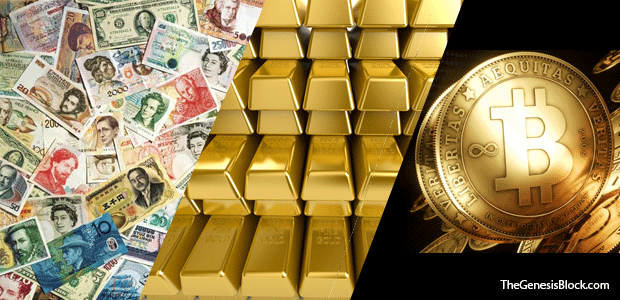
At a conference held last week in DC, the European Central Bank presented their opinion of virtual currencies including discussions about bitcoin. On slide 6 of their presentation they made a striking argument: bitcoin does not fulfill any of the three functions of money: Medium of Exchange, Unit of Account, or Store of Value. Most likely, their counterpoints to these three functions relate to the large volatility that bitcoin’s exchange rate has experienced since it’s inception.
While it is difficult to refute their exact points since the soundtrack is not included, it does raise an interesting question of how the properties of bitcoin compares to fiat and gold. There are nine distinct characteristics of money: scarce, durable, portable, divisible, easy to recognize, easy to store, fungibile, hard to counterfeit, and widespread use. At first glance, bitcoin has a significant advantage over fiat currencies and gold in many of these, and this will be even more obvious after a further examination.
Fiat money – a term used to describe currency that is officially used by a country. While many countries used to peg their currency to gold, this is not considered fiat. Fiat currencies are not directly convertible to commodities or pegged to the value of any commodities. Currently, a vast majority of the world’s currency are fiat.
Gold – this it is being used here as an example of a commodity money. Gold has been used as money for over 2,500 years in coin form, and is a popular store of value for those looking to diversify away from fiat money. For many years it carried significant advantages over any other form of money with respect to the 9 characteristics outlined earlier.
Bitcoin – is completely digital and not controlled by any government or business entity. Bitcoin issuance is scheduled, predictable, and finite. Addtionally, bitcoin transactions are verified by the largest computer network in the world to ensure transactions occur quickly and accurately.
This article will presume a fundamental understanding of the need for money, and how it functions as a medium of exchange, a unit of account, and a store of value. Additionally, this analysis will not address the infrastructure built around any of these products, since this infrastructure can largely be used for any of the three monies, and does not add to the comparison.
1. Scarce
Money’s scarcity should fall into a narrow band of objects that are widely available, however can not be easily created or found. Objects such as sea shells, which were once used as money, are too rare to be widely used except in specific locations, and objects such as sand are too abundant to have any significant value in small quantities.
| Fiat | Yes | Fiat currency can only be created by a small group of people creating a limited supply, however the actual cost of production is low so it can be created in large enough quantities to be readily available. Except in cases of extreme inflation, the scarcity of fiat currencies has held up well. |
| Gold | Yes | Compared to other precious metals, gold exists in an ideal combination of being rare to find (scarce), yet widely available (people have found an abundance already). Copper is more plentiful and difficult to transact in large values, and platinum is too scarce to be used for most transactions. |
| Bitcoin | Yes | The supply of bitcoin is tightly controlled and highly predictable. WIth some margin of error the supply of bitcoin can be forecast out 100 years. The 21 million units should be sufficient for large amounts of trade – accounting for its divisibility. |
2. Durable
To function as an acceptable store of value, a proper form of money should not degrade over time. Things that were previously used as money such as cattle and grain do not last for more than several years, and would not be considered durable.
| Fiat | Neutral | The paper that fiat currency is printed on is not an ideal medium for a longer term store of value. It is easily damaged, wears out after repeated use, and will degrade if proper measures are not take for long-term storage. However, damaged notes are easily replaced, so the actual value that it represents is not destroyed. |
| Gold | Yes | Gold bars will last hundreds of years with little maintenance. Gold coins may tarnish or become malformed with wear, however the metal itself will not degrade except under extreme conditions. |
| Bitcoin | Yes | Bitcoin is completely digital, so it will not degrade with use. Additionally, bitcoin wallets can be easily duplicated to prevent file corruption. Contrary to fiat, lost coins are not reprintable so extra care must be taken. |
3. Portable
Proper money should be able to be used in day-to-day transactions, and as such it needs to be highly portable in order to carry on one’s person. Money’s use as a medium of exchange is to make life easier, and most people would not consider carrying around large quantities of lead, or herding cattle to town for trade easy.
| Fiat | Neutral | Neutral For daily purchases, the money carried in a wallet will be sufficient. However, larger transactions require more elaborate measures such as armored trucks. There is additional infrastructure available such as debt or credit cards, however these come with associated fees and are not really an intrinsic value to fiat – if gold was popular to use the same infrastructure could be applied to that, or even cattle. It doesn’t reduce the inherent issue of storing paper fiat.No Gold is heavy, and even more difficult to carry than fiat money. |
| Gold | No | Gold is heavy, and even more difficult to carry than fiat money. |
| Bitcoin | Yes | Bitcoin scales exceptionally well for larger quantities since it is completely digital. Anything from $0.01 to $1B can fit on a flash drive. Additionally, bitcoins can be transferred almost instantly to a recipient anywhere in the world that is connected to the internet. |
4. Divisible
Few transactions in the world are for exact integer denominations. Almost every transaction has the need to make change. This can be achieved by storing different denominations of the money, or dividing physical objects into multiple segments without any loss of value. This make items such as art act poorly as money since the can not be easily divided.
| Fiat | Yes | Fiat is widely available in a large variety of denominations. Additionally, the fact that it’s printed on paper makes storage of a wide variety of denominations easy |
| Gold | Neutral | Dividing gold is possible, however it is not easily performed and requires a smelting process. Additionally, maintaining a variety of denominations in gold would be challenging due to storage concerns. |
| Bitcoin | Yes | Bitcoin is currently divisible up to 8 decimal places, and could be extended further if the need arose. At the current exchange rate of $100 this is a divisibility down to $0.0000001 |
5. Authenticity Verification
Money needs to be readily identified and verified. This reduces the risk to people accepting it for payment, and reduces the transaction time if it’s easy to verify the authenticity. Frequently, coins have their edge reeded to reduce clipping and value debasement.
| Fiat | Yes | Most people are comfortable with the visual and physical identification of currency from years of experience handling it. Additionally, there are quick chemical tests (using markers) that can assist in identification. |
| Gold | Neutral | As for commodity monies, gold is sufficiently different in color, weight and malleability from similar materials that these properties can usually be identified with a trained eye. Chemical tests can be performed to prove authenticity, however the process is significantly more elaborate than the fiat test. |
| Bitcoin | Neutral | Bitcoin cannot be visually identified since it does not exist in physical space. Software can be used to identify it in the block chain, however at it’s current stage this requires a fair amount of technical knowledge. Additionally, physical instantiations such as paper wallets and casascius coins are difficult to verify the true quantity of bitcoins stored. |
6. Storage
In order to operate as a store of value, it is necessary to be able to store in large quantities. Objects such as art and chemical compounds are difficult to store and require significant effort to maintain value. Livestock such as cattle used to be easy to store when land was abundant, however the mass migration to cities made livestock difficult to store in apartments.
| Fiat | Neutral | Because fiat currency does occupy physical space, they do require somewhat significant infrastructure to store. However their weight is relatively light, so this is easier than alternatives such as gold |
| Gold | No | Gold requires large vaults to store high value. Gold is infamous for requiring significant infrastructure to guard and store, such as Fort Knox. |
| Bitcoin | Yes | Similar to the portability characteristic, there are no scaling concerns storing bitcoin. There may be concerns as the block chain gets larger over the years, however this should scale appropriately with advances in hardware. Additionally, backup methods such as cloud storage of encrypted files and using Shamir’s Secret Sharing key add redundancy and reduce risk of loss due to error. |
7. Fungible
All units of the money must be considered equivalent, and equally replaceable. We’ll see art fail here again since different pieces of art will have significantly different values. Additionally, gemstones have a similar problem, as even diamonds of the same weight can have significantly different values due to clarity, color, and other characteristics.
| Fiat | Yes | All equal denominations are considered equal, i.e. all $10 bills are equally valuable. People don’t look usually look at the serial number or mint to determine the true value of the currency. |
| Gold | Neutral | At a chemical level all gold is the same. However different purity levels and stamping authorities have to be take into account. Frequently gold bars are weighted to examine for counterfeits since only the surface of the bars are readily examinable. |
| Bitcoin | Yes | Currently, all bitcoin are considered equal. There has been increased discussion about the purity of coins, and whether agencies should police transactions for stolen coins it is possible in the future that transactions will be penalized if stolen coins are mixed in, however this is still a significant way from implementation |
8. Difficult to Counterfeit
In order to be a reliable store of value, the object itself must be hard to counterfeit. Recipients should be confident that they are receiving authentic items, or else they will be reluctant to use it for trade in the future. Here cattle may have an advantage – since faking a live cow would be quite a feat.
| Fiat | Neutral | The US Federal Reserve estimates the amount of counterfeit USD has been as high as 50% of currency in circulation in the past, however this has estimate has dropped to <1% over the past few years. It is worth noting that North Korea is expected to be funding some of their operations with counterfeit super dollars that are nearly indistinguishable from $100 bills. |
| Gold | Neutral | While gold itself is almost impossible to counterfeit, there are numerous instances of gold bars being filled with lead or tungsten to reduce the true value of the asset. Frequently gold vaults will only test a small sample of the bars, so it is difficult to determine the true percentage of counterfeits. |
| Bitcoin | Yes | It is cryptographically impossible to counterfeit a bitcoin. The closest analogue would be attempting a double spend attack, where the recipient believes they received coins that were not actually transferred to their account. However, this has only occured once during the fork in March, and remains a low risk while the network hash rate remains high. |
9. Widespread Use
Lastly, money should be able to be traded for a wide variety of products and services. The reliability of being able to spend money when you need to, and not having to be concerned with whether a merchant will accept it adds significant value.
| Fiat | Good | Fiat is accepted at virtually every location within its issuing country. While many currencies with the exception of the USD has little use outside it’s political borders, it is easily traded for a local currency. |
| Gold | Bad | It is rare that anything can be bought directly with gold. It currently functions mainly as a store of value outside of it’s relatively small utility in jewelry and electronics. |
| Bitcoin | Bad | Bitcoin is only accepted by a small fraction of web sites, and an even smaller fraction of brick and mortar stores. While this number grows on a daily basis, it is still the vast minority of merchants. |
The Future of Bitcoin as Money
Fiat currencies and gold have hundreds or thousands of years of established value as money. They have been vetted by governments and have significant case-law to determine legal methods of use. Bitcoin is in it’s infancy and still in the price-exploration stage. The biggest complaint of detractors is concern over it’s price volatility. While this is difficult to debate, as the market matures and grows it will become less influenced by money entering and exiting the system.
When comparing the characteristics of money across fiat, gold, and bitcoin it is difficult to ignore bitcoin’s advantages. As bitcoin builds a solid history and clarifies regulatory concerns, its inherent advantages should provide ample opportunity to disprove the ECB that it really does provide the three functions of money.
Editor’s Note: Gold has been downgraded from Yes in the original publication to Neutral to proper reflect the difficulty of authenticity tests in point 5. A reference to the hard fork double spend in March was added in point 8.





How can the ECB not consider bitcoins money??? I wonder how high up the guy presenting was.
Let’s not try too hard to convince them that it is money…
I think that my bitcoins are still a better store of value and provide better price stability rather than gold, considering that you never know when some guy in some African country is going to kick up a fuss over making him dig up his gold in his country for export or even worry about when the next big gold heist is going to take place. Power to Bitcoin!!!
Wow, thanks for the thorough analysis!
I’m glad to be of service.
Does anyone know if the presentation was recorded anywhere? Or if there’s a transcript?
It’s only money for as long as it’s convenient to think of it as such – like convincing others that it has all the validity of a dollar, euro, yen, etc. When it becomes inconvenient – think regulation – many suddenly proclaim it as no longer being money, or being money but /special/ money that should be exempt from regulation because reasons. Not hating, just an observation.
Yes this is the nugget of it, ‘it’s only money for as long as it’s convenient to think of it as such.’ Now how can we tease out this thought space of what convenience really is? Are we saying convenience is some kind of acceptance recipe? I mean x, y, z crypto is more currency like if the number of merchants that accepts it is constantly growing month to month or the number of exchanges trading it are growing in volume trades? Do we need to factor in some kind of popularity index that takes ito account some calculation of migration from bitcoins to litecoins to feathercoins? Do we need to keep tabs on Avalon & Butterly ASICs sold? And of course regulation is a factor but can we create a regulation matrix with a heat map?
You mention a double-spend having never intentionally happening, what about the one against OKPAY during the March split?
https://bitcointalk.org/index.php?topic=152348.0
It does not appear that the double spend in March was done intentionally, but rather to a user becoming confused with the conflicting block chain forks. The real threat for a double-spend is if a user controls enough of the network to spend in on chain, have it verified, then create a separate chain where the coins were sent to another address.
No, it was definitely intentional. The user had been shorted by OKPAY and took advantage of the fork to force OKPAY to negotiate. See https://bitcointalk.org/index.php?topic=152348.0
I do not agree that the March double spend was accidental. If you read the thread I linked, the purpetrator included his BitcoinQT code modifications and strategy to intentionally cause a double spend in order to force OKPAY to pay him funds he was owed.
Here’s the post with the code:
https://bitcointalk.org/index.php?topic=152348.msg1626344#msg1626344
Additionally, a post replying to you explaining that the double-spend wasn’t accidental has been removed. It doesn’t seem like posters can remove their own posts; did you remove it?
This is a fair point, we’ll update the article to reflect that. I’m not sure what happened with the other post, but we have pretty aggressive spam filters so if there was a link it it, that may have caused an issue.
Cool; thanks for being so responsive and receptive in the comments.
Is Gold really easier than Bitcoin to authenticate?
Compared to a simple chemical test, the software required to authenticate the value in a bitcoin address is significantly more complex. Especially if the entire block chain must be downloaded and maintained as with the satoshi client. Given instructions I think most people in the world would find it simpler to perform gold authentication than bitcoin. This will get significantly easier as clients become more user friendly.
I don’t know where to get this “simple chemical test”, or how to use it to ensure that what I receive is not merely gold plated lead. But I know how to use any common computer or smartphone to navigate to bitcoin.info with nothing but a browser.
How does a chemical test distinguish a gold coin from a gold-plated lead coin?
I should have mentioned that chemical tests are used in conjunction with weighing (as referred to in other sections of the article). We’ve downgraded the ease of verifying gold to be comparable to bitcoin.
Bitcoin does have a durability problem. If you lose the key/password to your software wallet the money is gone forever. If you die, how do your children inherit your Bitcoins ?
What you need is the ability to give other people contingent rights over your Bitcoins . Such services should be opt-in rather than compulsory, and at the edge of the network not in the core.
Absolutely correct. The time has come for online personal pharaoh tombs. Your PT would include all your digital assets + timeline photography + your comment stream. Your children could have revocable or irrevocable keys to your PT. Also, wouldn’t it be possible to bequeath bitcoins in your Will as the law is written today? If not then here’s some real creative legal work in virtual personal space law. Of course this builds on archives and trusts. We will come to a time when people will take into consideration PTSL (Pharaoh Tomb State Law) when choosing between Florida and Panama.
Bitcoin does not have a durability problem – your keys can be duplicated and distributed so that, in fact, they can never be destroyed. That you don’t provide a recovery method for your next of kin is not bitcoin’s problem the same way that not telling them the geo coordinates of your gold stash. Things like Shamir’s Secret Sharing Scheme make it easy to ensure family members have access to you bitcoins when you pass, yet secure while you’re alive.
To verify the authenticity of a Bitcoin that has been transferred you need to do nothing, your software will tell you that you have received bitcoins and how many confirmations are there. You don’t need special tools or knowledge to validate that a Bitcoin is authentic.
Same goes for a private key, there are many sites that you can use to obtain a Bitcoin address from it and verify that it contains the alleged amount of bitcoins. No esoteric knowledge there.
I would argue that it is harder to authenticate gold than Bitcoin. Most people do not see gold in a regular basis, and cannot reliably identify it.
This is true. I was more referring to the barrier to entry that exists for a majority of people for setting up, understanding, and trusting bitcoin software. You make a fair point, along with some other commenters, that gold is not easy to authenticate so we’ve downgraded it.
I would imagine ECB don’t consider Bitcoin meets their three criteria – Medium of Exchange – it’s not accepted at enough places. Unit of Account/Store of Value – because the value fluctuates so wildly. All of these arguments have been refuted in other articles, but it is interesting to see ECB take such an interest in Bitcoin.
“faking a live cow would be difficult” xD
i guess money is worth what it is worth where you plan to spend it, a cow may be more useful in some situations.
Dare I say I’d disagree with your physical assumptions of fiat currency, generally this is free and sailing in the electronic system now.
For example we where using gold as a currency before the fed cracked down on it, and if anyone did use it as a currency, we would not be carrying about gold bars, it would be cheques or IOU’s representing gold (pegged money)
We removed the infrastructure in place around these forms of money to make a fair comparison. Bitcoin has a lot of those properties built in, and does not rely on a 3rd party infrastructure. Theoretically you could use credit cards as a medium for paying in anything, however there will be fees and counter-party risks associated with that that are outside the scope of this article.
As much as your analysis is appreciated I think you are highly biased in your analysis and there are several things which I think are very much debatable: First of all you took the status quo as basis for your analysis. If you want to analyse these three “monies” in a fair light you’d have to imagine different scenarios where each is the dominant “money”. Currently fiat is the de facto currency of the world. If gold was the de facto currency instead many of the things you mentioned were different. For example there would be even more denominations in all (realistic) sizes/weights as there are now. Very soon a very select few of different products would become widely known to people (e. g. Krugerrand, Maple Leaf, Eagle and Philharmonic) and become “the standard” (which is actually happening right now although the market is so small); other products would be regarded as “non standard” and most likely disappear or traded for less (and then disappear thereafter). Along with this development people would become experts at spotting counterfeits very fast (especially because of gold’s extreme high density of wealth). Testing tools and chemicals would be widely spread. So I think the fungibility argument is not really valid. (Bitcoins are fungible for all intents and purposes – even more than any other of the three.) The next “misleading” argument is storability: a) someone who owns more than a hundred thousand dollars worth of Bitcoin will probably not trust in a single flash drive and maybe one backup on another flash drive (I certainly wouldn’t). b) you say that fiat doesn’t take much space as opposed to gold – which is absolutely bogus: considering the highest current denomination of the dollar is 100 $ and 500 € for the euro volume wise gold needs much less space. You said the problem with gold is that you need a vault: this is very “misleading”! If you do not own a lot of money, storage wouldn’t be a problem at all space wise. Let’s assume that 98 percent of all people on earth have a net value of less than 200 thousand dollars – at current value that is a little over 142 one ounce coins, i. e. 7 tubes of twenty ounces each plus two extras. This volume is approx. less than a Harry Potter book (and less than the same amount in fiat). If you have more than let’s say ten thousand dollars worth of any of these three monies stored at home it would considered grossly negligent by any reasonable person to not protect it against theft. So once you have to store a certain value at home (or office or any place other than a bank) you will always need some kind of “vault” or safe (even for your special flash drive). Now to usability: from today’s point of view Bitcoin is not at all useable – it is simply to complicated for Average Joe and it is far too unsafe: losing your wallet or your password is still the biggest problem to make it interesting for non techies. In a scenario where Bitcoin was the de facto currency of the world a lot of these problems would have been fixed and it would be widespread as opposed to now. Granted. But still it would be an everlasting cat and mouse game to keep it as safe as fiat is now and it would require constant learning/training for all users to stay a safe currency. Don’t get me wrong i really like the Bitcoin concept and I think it will grow. But due to the aforementioned reasons it will take a lot of time for Bitcoin to become really big. Maybe the reason mentioned last will be it’s biggest problem…ok enough with the criticism for now
Thanks. I was waiting for somebody to say this because I hate writing lengthy arguments. Fiat is just as durable, portable, and storable as bitcoin because most of it is transacted electronically. The ability to cash it out into paper currency reinforces the perceived value of fiat, but it’s not really an added convenience. For example, wouldn’t it be great to just make payments with an RFID ring and PIN authentication? It’s technologically possible, but tangible paper/metallic currency serves a purpose. It adds to the stability of fiat currency.
There is no mention of taxes. You must pay taxes with a state sanctioned currency. This is probably the most significant aspect of money which is not proved by bitcoin.
You can’t pay your taxes in gold – that doesn’t mean gold is not money.
doesnt whether a currency/money is a store of value relate to how well it retains it value over time & ability to purchase real goods like food/land/energy etc… not what the article addresses, which is how easy it is to store fiat vs gold vs bitcoin in a vault etc… seems to me this is a huge mistake?
I’m not sure where you’re getting your info, but great topic.
I needs to spend some time learning more or understanding more.
Thanks for excellent info I was looking for this information for my mission.